
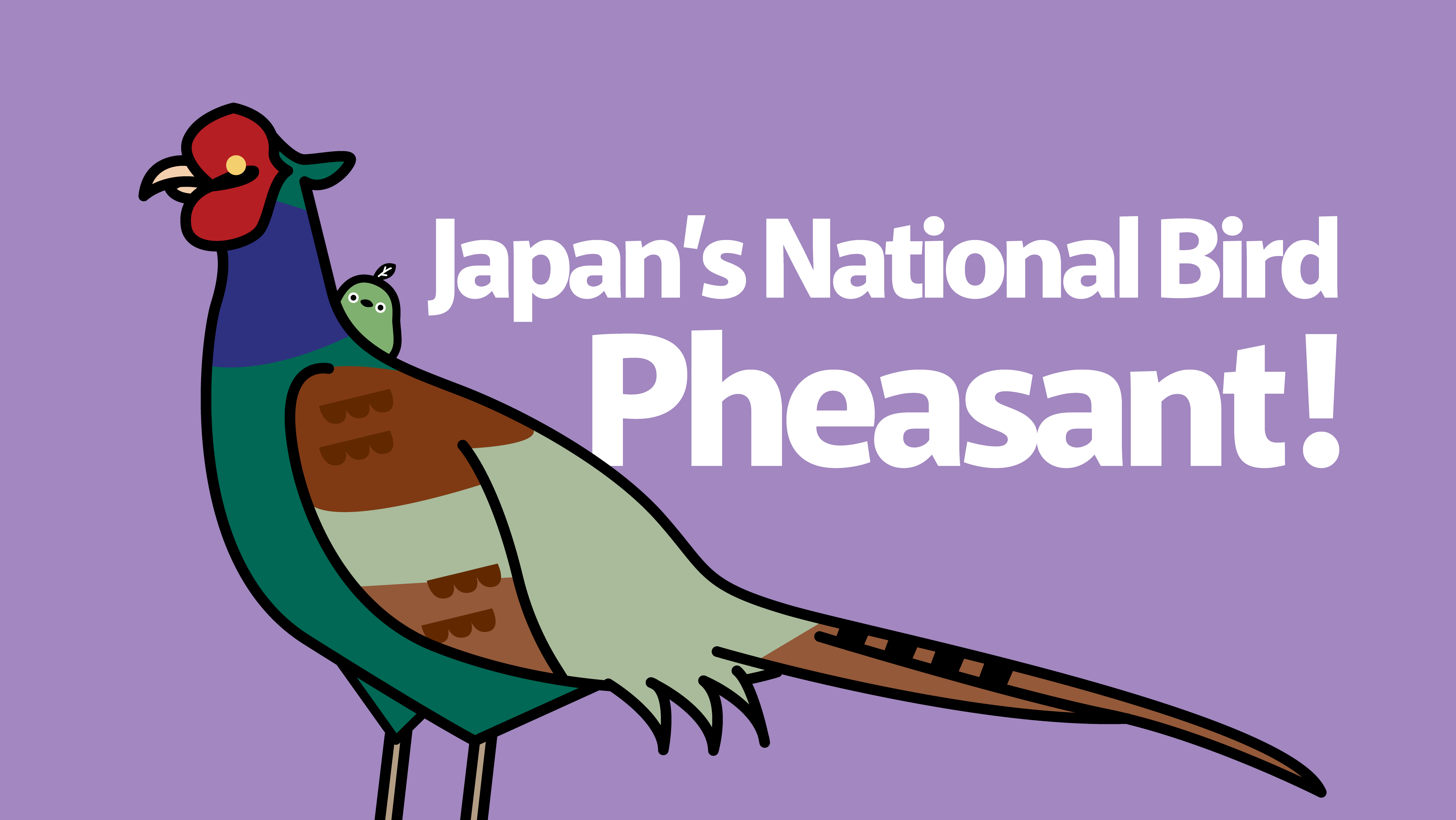
Hello everyone! You’ve probably heard of the “kiji” (pheasant), right? That famous bird from the Momotaro folktale. In fact, the pheasant is Japan’s national bird—and it’s actually a species found only in Japan!
Male pheasants are about 81 cm long, and females about 58 cm, making them surprisingly large birds. The male’s body shines with a bluish-green iridescence, beautifully contrasted by the red wattle on its face. On the other hand, the female has brownish plumage, which may seem plain, but serves an important role—camouflage to protect her while raising chicks. It’s fascinating how their appearances reflect their different roles.

The pheasant wasn’t chosen as the national bird just for its beauty. It lives in Japan year-round and can often be seen in rice fields and grasslands—it’s a familiar sight. While not great at flying, pheasants are very fast runners, reaching speeds of up to 32 km/h! What’s more, pheasants are said to have the ability to predict earthquakes. They can sense subtle tremors that humans can’t and sometimes call out just before a quake. There’s even an old saying: “When a pheasant cries, an earthquake is coming.” Incredible, isn’t it?
In addition to the Japanese pheasant (Nihon-kiji), which is Japan’s national bird, there is also the common pheasant (Kōrai-kiji), originally from China. It was introduced to Japan for hunting purposes and has become wild in regions like Hokkaido and Okinawa, where the Japanese green pheasant was not originally found. Although the two species look quite similar, a distinguishing feature of the male common pheasant is the white ring around its neck.
So next time you hear a loud “Keeen!” cry from the grass or a rice field, it’s probably a pheasant. Take a moment to stop and try to spot its bold and beautiful figure. See you next time!


