
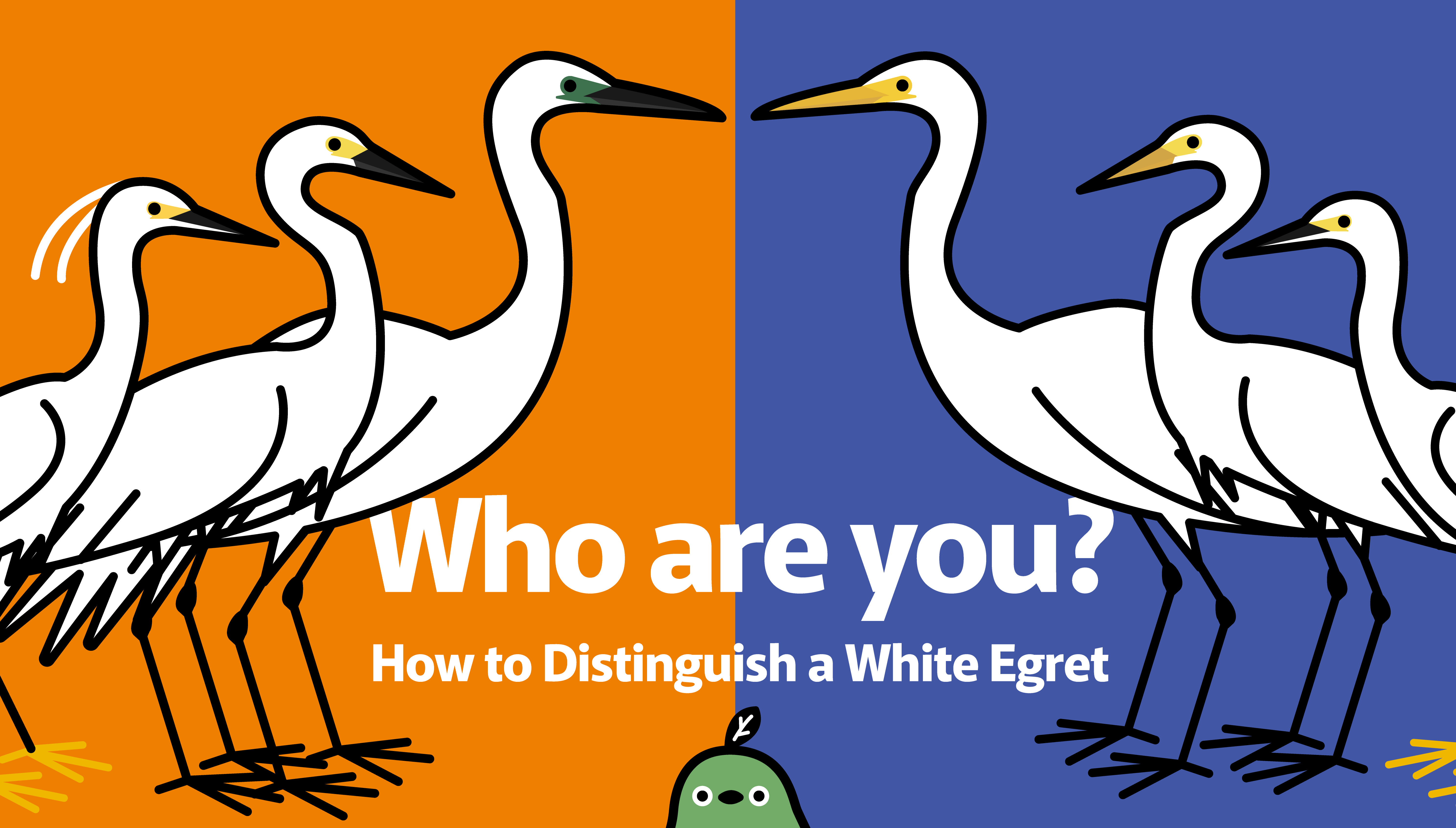
Hello everyone! Whether you’re a birdwatching enthusiast or not, have you ever noticed those beautiful white birds in parks or along rivers? These birds, known as “shirasagi” (white egrets), may all look the same at first glance, but with a few key points, you can tell them apart! Today, let’s enjoy learning how to distinguish the Great Egret, Intermediate Egret, and Little Egret!


Great Egret: The Elegant Giant

First up is the Great Egret. Measuring about 90 cm in length, it is the largest of the egrets you’ll encounter. Its signature features are its long neck and legs. Often, it bends its long neck into an S-shape. In summer, its beak and the base of its legs turn stylishly black, while the area around its eyes transforms into a fashionable yellow-green! The egret also grows decorative feathers along its back. One key identification point is that the corner of its mouth extends beyond the back of its eye. Its call is a deep “Gwaa” that resonates across the area, and when another Great Egret approaches, it fiercely chases them away with a louder “Gaaah.”
Intermediate Egret: Herald of the Seasons

The Intermediate Egret is slightly smaller than the Great Egret, measuring around 68 cm. In Japan, it visits as a summer bird. Its trademarks are a yellow beak and eye area. In summer, the beak turns black while the eye area stays yellow. The straight, elegant plumes on its back during summer are striking. Unlike the Great Egret, the corner of its mouth aligns with the back of its eye. Its call is similar to the Great Egret’s “Gwaa” but sounds slightly higher.
Little Egret: Small but Full of Charm

The Little Egret is the smallest of the three, standing about 60 cm tall—just a bit larger than a crow. Its beak remains black year-round. In summer, it sports two long, thin crests on its head, and its back is adorned with lace-like plumes that curl at the ends, giving it a charming appearance. Its feet are black, but its toes are bright yellow. Its calls—”Gyau,” “Gaa,” and “Gao”—are lively and energetic. The corner of its mouth extends in front of its eyes. In spring and early summer, its face and toes turn pink for a brief period as part of its breeding display. If you catch sight of this, consider yourself lucky!
These egrets may share the same brilliant white plumage, but their feather length, color changes, and vocal differences showcase their unique personalities. Next time you’re at a park or by the river, try identifying which egret you’re seeing. See you next time!


