
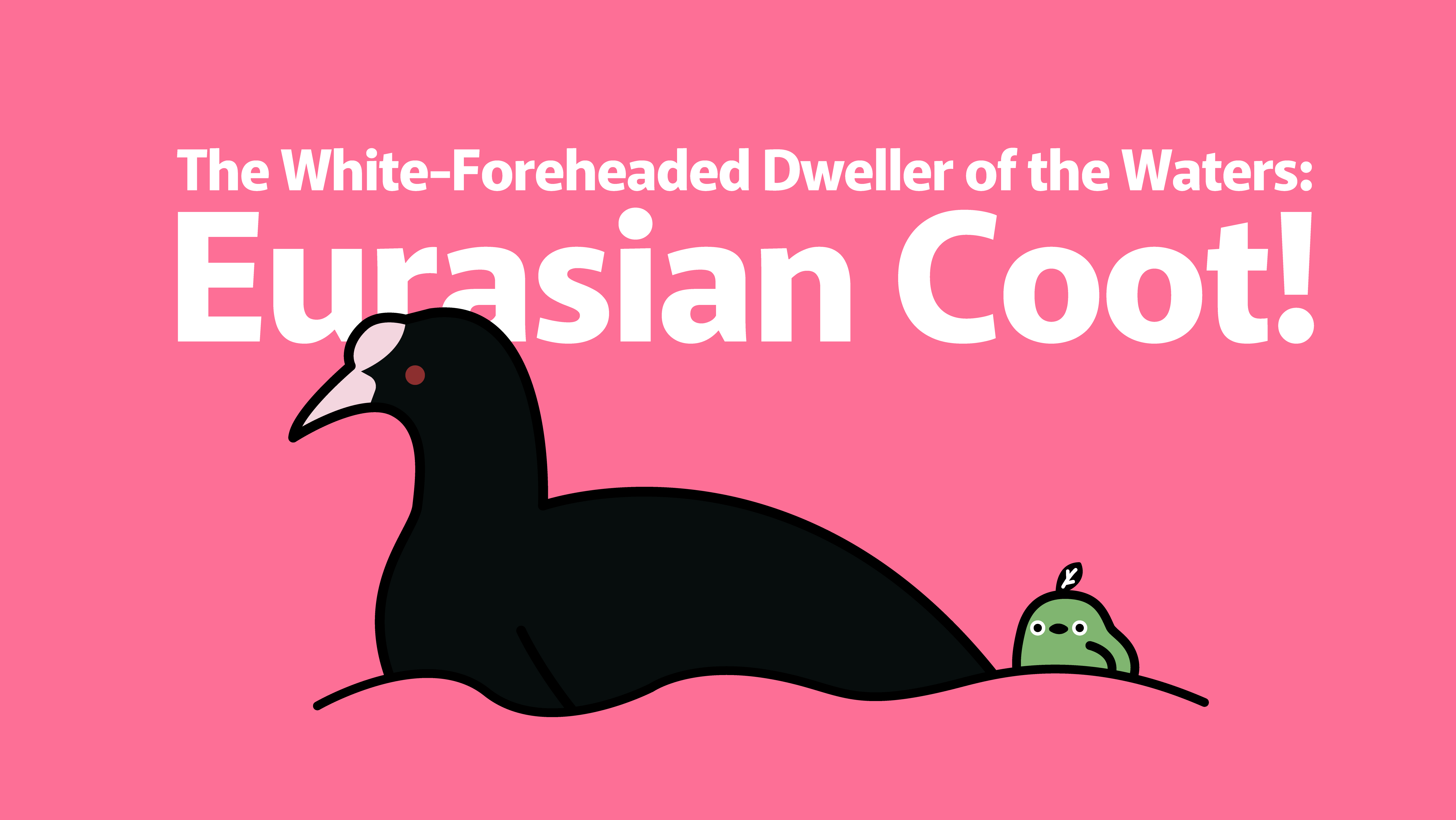
Hello everyone! Have you ever heard of the Eurasian coot? This bird, with its stylish appearance and unique ecology, quietly goes about its life in nature close to us.
The Eurasian coot, larger than its relative the moorhen, can reach a length of about 39 cm. Its most striking feature is its coloration. The body is elegantly grey-black, with a prominently white bill and frontal shield (forehead). Moreover, its toes have leaf-like lobes, indicating its proficiency as a swimmer.

Although it resembles a duck, the Eurasian coot is actually related to moorhens and rails. Despite its appearance, it is highly capable, swimming and diving swiftly in water. It primarily lives near water but can also be seen walking on land, emitting a distinctive ‘kyuitt’ sound.
Its diet is omnivorous, favoring aquatic plants but also consuming fish, insects, and even the eggs and chicks of other birds. During the breeding season, it builds nests in or near water by piling up plants, laying 1 to 13 eggs.
In Japan, it used to breed mainly north of the Kanto region, but recently its numbers have increased, and it can be seen throughout Japan. In the West, it is viewed as a symbol of beauty and elegance. Interestingly, there’s also an expression, “as bald as a coot,” referring to its bald-looking forehead.
The Eurasian coot plays an essential role in aquatic ecosystems. Learning about its charm might make your next bird-watching experience more enriching. Their beautiful black feathers and white frontal shield add to the richness of our nature observation experiences.


