
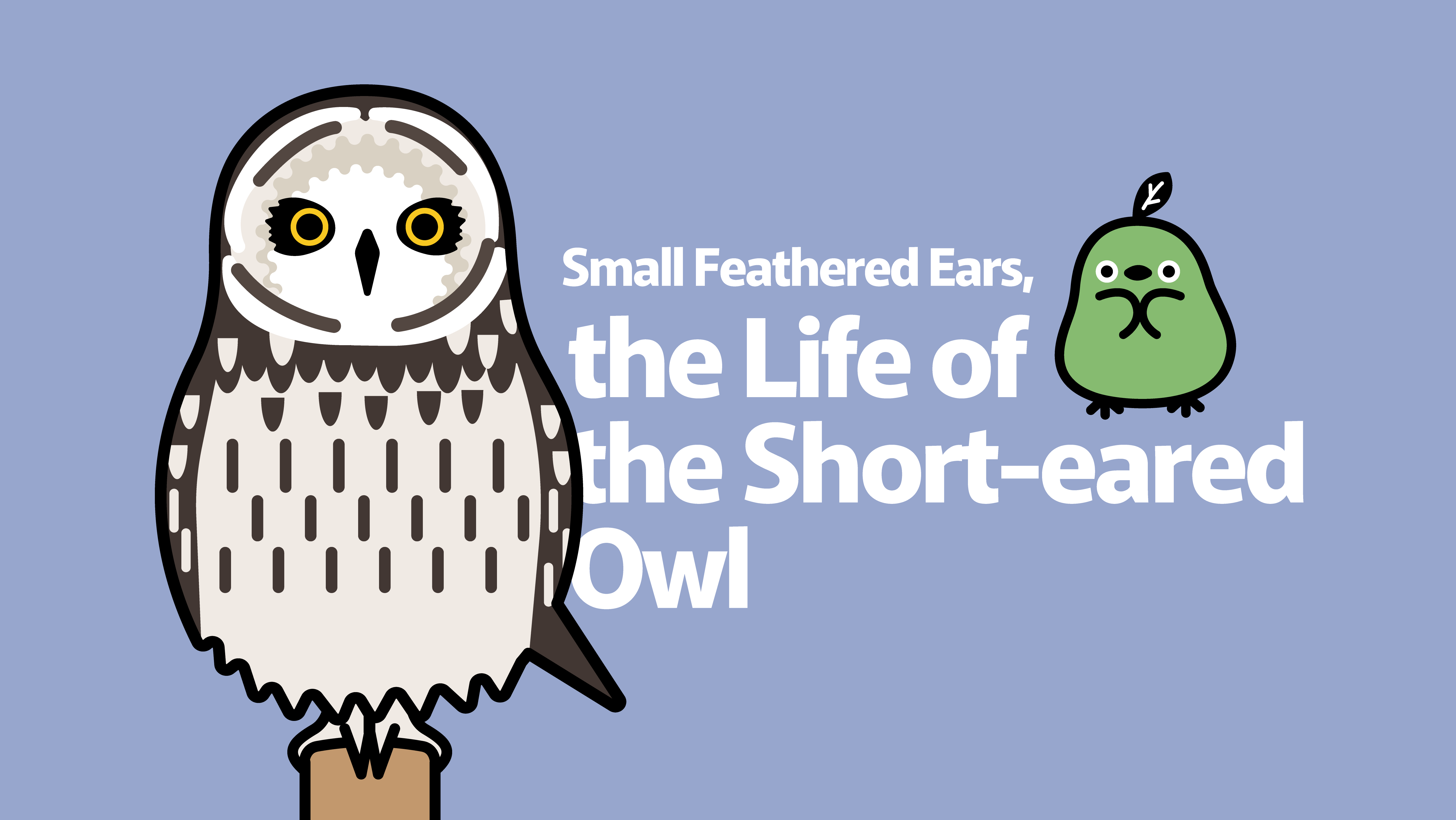
Hello, readers! Today, let’s talk about a rather unique bird, the Short-eared Owl.
The Short-eared Owl is a medium-sized owl, slightly larger than a pigeon, measuring about 38 to 40 cm in length. It has a distinctive appearance with a pale face, light brown belly, and brown vertical stripes. These stripes act as excellent camouflage, blending into the surrounding environment. The wings of the Short-eared Owl are quite large compared to its body, spanning about 1 meter when extended. Its flight is truly beautiful.

Firstly, the Short-eared Owl is a migratory bird. As the colder seasons approach, it flies from northern areas like Siberia to warmer regions like Japan. It’s not commonly seen everywhere in Japan, and is quite rare in places like Okinawa.
Generally, owls with feather tufts that look like ears are called “eared owls,” and those without them are known as “owls.” The Short-eared Owl, true to its name, has very small feather tufts. Its name comes from these tiny tufts, which are more a trademark than an indication of body size. Thus, at first glance, it might look like a regular owl. But its round, flat face, yellow eyes, and distinct black eyeshadow are truly captivating.
Interestingly, Short-eared Owls sometimes form small groups in winter, which is uncommon for birds of prey that typically are solitary. This grouping behavior, including sleeping together, is a unique characteristic not commonly seen in other owls or eared owls.
Though nocturnal, the Short-eared Owl can often be seen active during the day near water bodies and marshlands. It is a rare “grassland” species among owls, preferring to hunt in open fields and rest in bushes or low trees. This makes them quite popular among bird-watching enthusiasts. They primarily feed on rodents and insects, earning them the nickname “field mouse hunter.”
So, the Short-eared Owl, with its small tufts, is a very unique bird. As a migratory bird, it brightens up the Japanese winter and delights us with its adorable appearance. If you happen to spot a Short-eared Owl, remember its features and behaviors, and enjoy observing this charming bird!


