
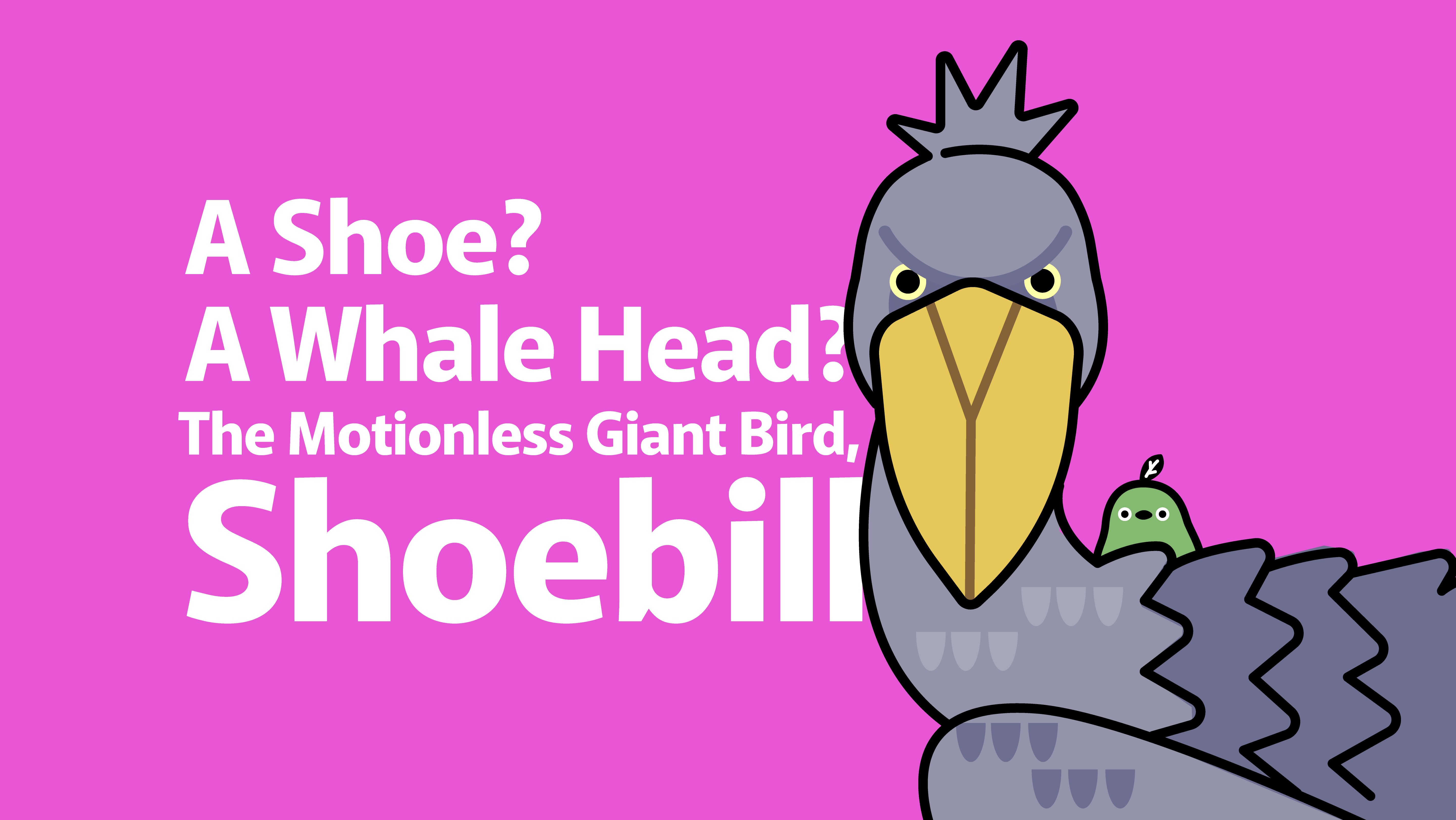
Hello, everyone! Today, I’m going to introduce you to a giant bird that quietly lives in the wetlands of Africa, the “Shoebill.” It’s filled with a mysterious charm in both its appearance and ecology!
The Shoebill is known for inhabiting the wetlands of East to Central Africa. Its appearance is almost reminiscent of a dinosaur. It can grow up to 150 cm in height and has a bluish-gray plumage with a greenish sheen. Its bill, very large and wide, is a pale yellow with gray patterns.

Its appearance is very impressive, and it is also called “Shoebill,” meaning a “bill like a shoe.” Furthermore, it has the English name “Whale-headed Stork,” which means “a stork with the head of a whale” – quite unique indeed.
The most distinctive feature of this bird is its lack of movement. It is also called “the motionless bird” because it can stay still for hours waiting for prey. The reason for this stillness is to avoid alarming the fish. It especially targets lungfish, which come to the surface to breathe. It does fly occasionally when it needs to change locations if it can’t catch food. The maximum flight distance is about 500 meters, but this is a rare and valuable sight.
Interestingly, the Shoebill’s vocalizing function has degenerated, and it rarely makes sounds. For communication with its peers, it uses a behavior called “clattering,” which involves rattling its bill. It also sometimes shows a bowing gesture towards humans, which might indicate affection.
The Shoebill is an important presence in preserving the wetlands of Africa. However, its population is estimated to be between 5,000 and 8,000, and it is listed as an endangered species. In Japan, you can see the Shoebill in several zoos. The existence of this quiet giant bird may teach us the importance of nature! See you again next time.


