
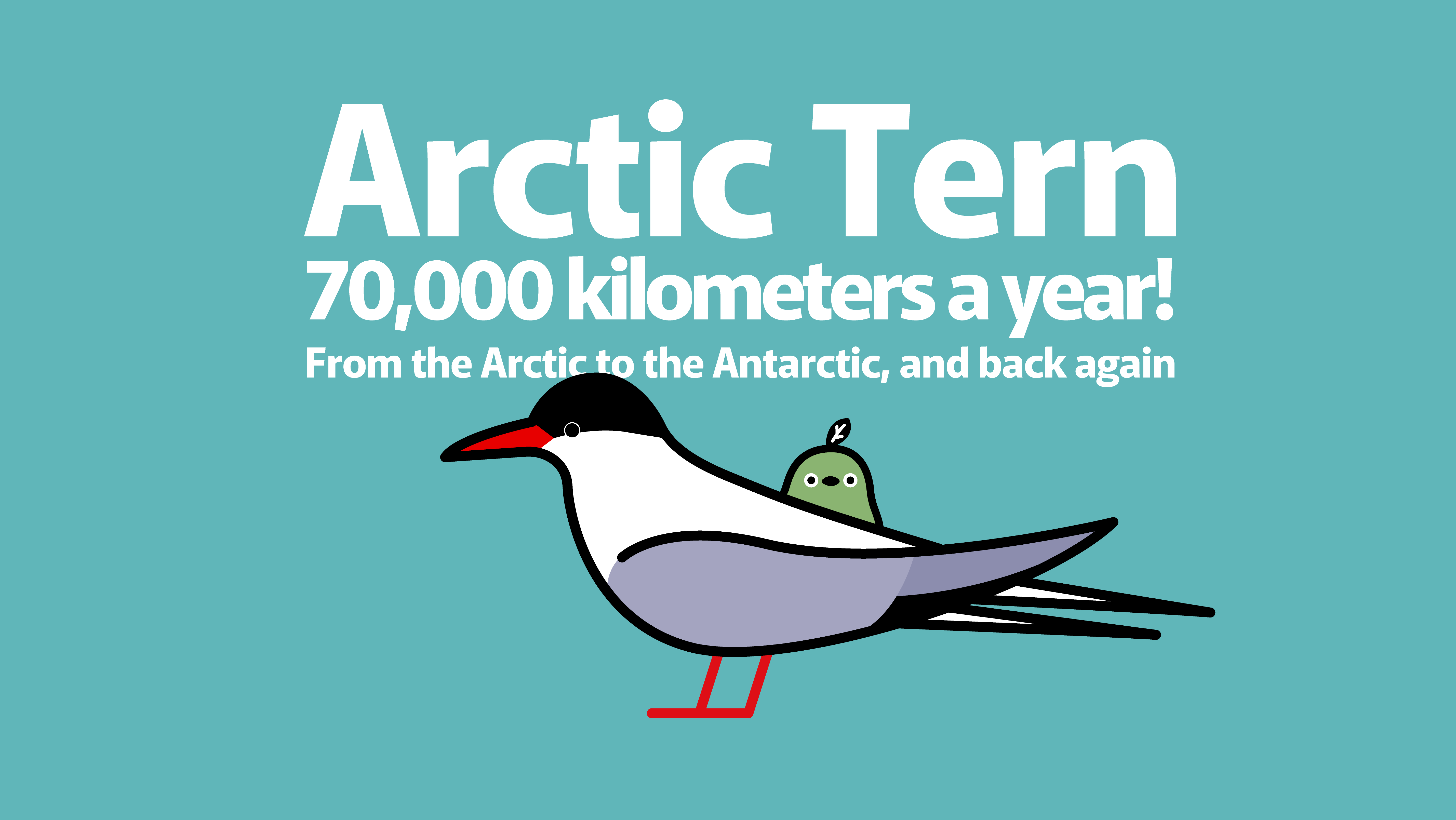
Hello, everyone! Have you ever heard of a small bird called the Arctic Tern? It’s only about 35 cm long — about the size of a pigeon — yet it undertakes a globe-spanning journey every single year!
Adult Arctic Terns in their summer plumage have red beaks and feet, a black cap on their head, and a sleek pale gray back. In contrast, their winter plumage features darker beaks and feet, with the black extending to the back of the head — a kind of “seasonal wardrobe change” that marks the start and end of their epic journey. One way to distinguish them from similar tern species is by their slightly shorter beak and legs, and of course, their striking red accents.

Their most astonishing trait? Arctic Terns make the longest migration of any bird — traveling between the Arctic and Antarctic regions. They raise their chicks in the Arctic during the northern summer, then head to the Antarctic before winter hits, enjoying another “summer” in the southern hemisphere. In other words, they experience two summers every year. Their round-trip journey can reach up to 72,000 kilometers annually — The Arctic Tern’s lifetime flight distance is estimated to be around 2.4 million kilometers — that’s the equivalent of circling the Earth about 60 times! It’s such an astonishing number, it almost makes you laugh.
Their migratory route shifts slightly depending on wind, ocean currents, and food availability. Gliding over the ocean, they search for small fish and other prey to maintain their strength. They’re experts at catching thermals to soar long distances with minimal energy.
By the way, since Japan lies outside their main migratory path, it’s extremely rare to see them here. But every now and then, one might get lost and appear as a stray visitor. Imagining the Arctic Tern’s extraordinary journey can be a fun way to dream of distant skies. Until next time!


